Requirements
Assay requirements
The proposed screening assay should meet the requirements listed in the tables below and the owner should have hands-on experience with the assay.
If the assay does not fully meet the requirements, it should be made clear in the application form what is needed in terms of resources and assistance to bring the assay up to standard. If you have developed a validated 96-well assay but do not have access to 384-well microtiter compatible plate readers or need advice on assay development in general, please contact the European Screening Centre. We are happy to advise on miniaturisation to 384-well format and discuss arranging a site visit for you to upgrade your assay to meet the European Lead Factory standards.
Please note that:
- Assays in ELISA format are not eligible for submission, unless the assays can be converted to a homogenous format.
- In case one or more assay reagents are carcinogenic or mutagenic, please search for alternatives in line with the European legal framework.
- Kinetic measurements on the HTS system have limitations; alternatives are recommended.
-
Assay requirements for High Throughput Screening
Characteristic
Requirement
Assay format Demonstrated in 384-well format,
scalable to 1536-well formatHomogenous assay No wash steps Characterised reference Available from partner or commercially available Read out technology Compatible with mix-and-measure and homogenous formats, e.g.:
- Absorbance
- Luminescence
- Fluorescence intensity
- Fluorescence polarization
- Fluorescence resonance energy transfer (FRET)
- Time resolved Fluorescence (TRF)
- Homogeneous Time Resolved Fluorescence (HTREF /TR-FRET)
Or alternatives that give highly specific readouts (e.g. AlphaScreen technology, fluorescence lifetime, fragment complementation or FLIPR for calcium readout)
Signal / Background (S/B)
in 384-well plate format
Max assay end volume 30 µlSample end concentration 10-5 M
Ideally > 3 or higher
S/B = high control signal / low control signal
Z' (Z prime)
in 384-well plate format
Max assay end volume 30 µl
Sample end concentration 10-5 M
> 0.6 Z' = 1 - (3 (s. d. high control + s.d. low control) / (mean high control - mean low control))
DMSO tolerance Minimal tolerance 1.0 % DMSO Stability of each reagent Stable for at least 8 hours
For proteins: proven freeze-thaw cycle stabilityCell lines Certified mycoplasma free
Stable cell lines available for transferCertified mycoplasma free
Stable cell lines available for transferCV <10% across plate filled with reference compounds Protein Recombinant protein at least 80 % pure
Provided by you, or feasible to produce on milligram scale (construct and protocol available for transfer)
Incubation times Up to 4 hours Readout stability For at least 1 hour Experience Hands on experience in running the assay Experimental data Experimental data -
Assay requirements for High Content Screening
Characteristic
Requirement
Assay Format
Demonstrated in 96-well format, preferably available in 384-well format Controls - Phenotype(s) of interest can be measured quantitatively in the proposed assay with and without stimulus or inhibition.
- Control(s) are available from the proposer or commercially available and in quantities to allow scale up.
NB The control(s) does(do) not necessarily need to be a small molecule(s).
Read out technology - Fluorescence based imaging (confocal or not)
- Fluorescence resonance energy transfer (FRET)§
- 2D or 3D, 2D+t, 3D+t
- Transmitted light imaging e.g. bright field or phase contrast
- Flow cytometry
§ possible at certain sites only
Assay Robustness Plate statistics are available for the assay, such as:
- Heat map of the assay in a plate format
Provide data on inter-plate variance (technical and biological replicate data).
Signal / Background (S/B) > 2 preferably
S/B = (high control signal) / (low control signal)
Z’ (Z prime) Z’ > 0
performed with at least 8 wells of positive controls, and 8 wells negative controls.
Z' = 1 - (3 (s.d. pos control + s.d. neg control) / (mean pos control - mean neg control))
% coefficient of variation (%CV) - Overall %CV (whole or half plate of controls) <10%
- Column/row %CV data ideally <10% (depending on S/B
DMSO tolerance Minimal tolerance 0.5 % DMSO Description of phenotypic analysis routine - Image processing, analysis and quantification workflows are available (including software used).
- In case of Flow Cytometry assay, gating and measures are available.
Cell lines - All cells are certified mycoplasma free
- Stable cell lines are available for transfer
- Demonstrate enough source material is available for screening around 50,000 compounds in 96-well or 384-well format.
- For iPS-derived cells – special requirements are established (bankable progenitors, differentiation timelines etc)
- For Co-culture models: special requirements are established.
- Other unusual growth conditions or technical requirements eg specific plasticware are known.
Other info related to reagents and readouts - Details of fluorophores used in staining and or fluorescent proteins used in the assay or in cell lines are known and can be detailed.
- Stability of assay/labelling reagents (Abs or other dyes) are known.
- There is a sufficient supply of antibodies and other key reagents.
- Anticipated treatment time is known.
Readout stability - Fixed end-point assay preferred
- With staining/signal stable for > 1 week at 4 deg C or >1 day at RT.
- Live cell assay: depends on the readout/stimulus/ timecourse.
Experience Current hands on experience in running the assay Experimental data Experimental data available -
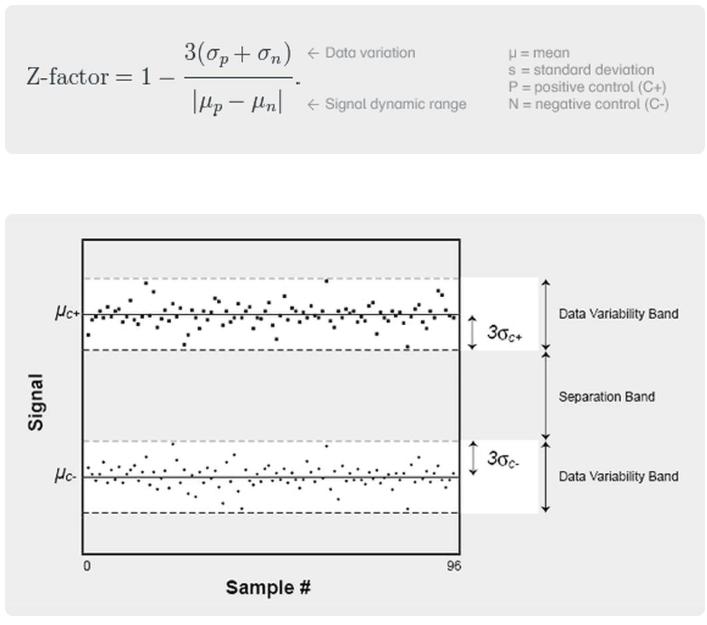
Calculating your Z' alias Z prime alias Z-factor
Please note that Z prime should not be confused with Z-score or Z-value!
The Z-factor is an attempt to quantify the suitability of a particular assay for use in a full-scale, high-throughput screen.
The Z-factor is defined by four parameters: the means (µ) and standard deviations (σ) of both the positive (p) and negative (n) controls.