

News
In conversation with the ELF Programme Clearance Team
As part of a series of interviews that put members of the European Lead Factory (ELF) in the spotlight, we recently had the chance to speak with all three members of the ELF Programme Clearance Team (PCT): Phil Jones of BioAscent, Steven van Helden and Freek Janssen of Pivot Park Screening Centre (PPSC). They told us about their role as the PCT and their experience in selecting the best and most interesting compounds for ELF Programme Owners.
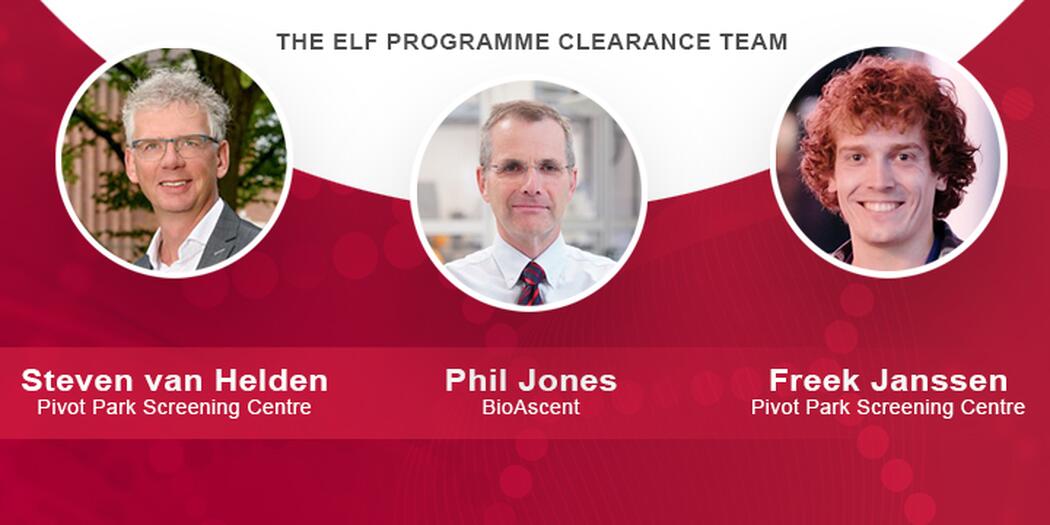
Phil, Steven and Freek are all chemists by training with a passion for drug discovery. “The reason I became a medicinal chemist,” said Phil, “was to make drugs to help patients.” This is a sentiment shared by all three and one which explains what the ELF is all about: a public-private partnership of like-minded and experienced drug discovery partners that are looking to find new molecules for new medicines that will ultimately benefit patients in need.
So, without further ado, let’s hear from the experts themselves and find out what it is they do as the ELF PCT.
Can you each introduce yourselves and explain your backgrounds?
Steven: “I’m a computational chemist by training with 20 years of pharmaceutical industry experience. I’m currently the Chief Technology Officer at PPSC and I’ve been involved in the ELF right from the start in 2013.”
Phil: “I’m the Chief Scientific Officer at BioAscent and a medicinal chemist by training. I joined the pharmaceutical industry 35 years ago and like Steven, I’ve been involved in the ELF since 2013.”
Freek: “I have a background in Medicinal Chemistry and Chemical Biology with a PhD from the department of Molecular Physiology at Leiden University in the Netherlands. I completed my PhD in 2016 and then did a post-doc at Radboud University. In January this year I joined PPSC and became the newest member of the ELF PCT.”
Tell us about the PCT and what your role as a team entails
Freek: “The PCT is involved in all ELF programmes and is responsible for the selection of the best hit compounds for each programme. We get involved right from the start through recommendations regarding assays and specifically with regards to designing what's called the triage cascade. After screening we select Preliminary Hit Lists based on the assay data obtained, recommend follow-up work, and ultimately select the Qualified Hit List (QHL), including recommendations on resynthesis. Our job is to select the best quality compounds and hits for ELF programme owners, as they are not able to see the chemical structures themselves at this stage of the process. Finally, we also provide recommendations for follow-up work based on resynthesized QHL compounds.”
Steven: “It’s important to reiterate this aspect of the project that Freek has touched on. In the ELF, it’s during the screening phase that the biology and chemistry meet. The ELF differs from so called ‘normal’ screening projects where both the biology and the chemistry are discussed early on with the ‘client’ or programme owner (PO), as we call them. In the ELF, involving the PO in the process of evaluating the structures to end up on the QHL is not possible due to the very special compound library we have and all the protection rights and legalities associated with it. Our role as the PCT is to make sure the chemistry is properly covered within the legal limits. Another important feature of the PCT is that we are the only ones who get to see details of all ELF programmes. We therefore also have a role to play in ensuring that the quality and standards across all programmes within the ELF portfolio remain consistent. If there are any potential issues with compounds, purity, or types of structures, we are the team to flag this. Ultimately, we are the ones who determine which compounds the programme owners receive.”
Phil: “Indeed, the PCT has a rather unique role, as Steven and Freek have mentioned. During the programme selection process, we are the only ones to have access to the chemical structures in the compound library. Furthermore, because there is great sensitivity around chemical structures in the selection phase, the pharmaceutical companies in particular want to ensure that the structures that eventually do not go to the programme owners are protected and not widely seen. This is another role that the PCT fulfils. Basically, for selection of the triage, there's a phase when a lot of biological information is recorded on the compounds without knowledge of the chemical structure. In order to make the final selection of compounds of most value to the programme owner, there needs to be sight of the structures by experienced medicinal chemists. This is where we as the PCT come in. We get to see several hundred structures for each programme and we select up to 50 compounds to become visible to the programme owner.”

Steven van Helden, PPSCThere’s a range of technologies available through the ELF that enable us to not only carry out the screening, but also validate the hits and gain the information needed. The expertise and facilities on offer in the ELF is really quite unique.
What is it that makes the ELF compound library so attractive?
Phil: “From my perspective it’s the range of sources that makes the collection so unique, with its origins stemming from multiple companies. The collection brings together the compounds of eight different pharmaceutical companies. These are compounds that come from their private collections – many of which will not have been seen before by scientists outside of these companies. From that perspective alone it really is a special collection.
“Furthermore, the library is of a significant size with over 500,000 compounds – only the major pharmaceutical companies have libraries of this size. What also makes it special is that approximately 200,000 of the >500,000 are compounds designed from crowd-sourced ideas from around Europe. This means we’ve got a unique collection of compounds that has been specifically designed and then reviewed by medicinal chemists.”
Steven: “Importantly, there is also evidence that the collection works with several ELF programmes that are now close to the clinic. Another aspect that speaks to the quality of the collection is that some of the pharmaceutical companies have been able to revive projects that were previously unsuccessful when screened against their own compound collections – these are collections larger than 1 million compounds from which they were unable to find good hits. When they screened the combined ELF collection, however, they found interesting hits that enabled them to continue their projects. This shows how special this collection is. It’s proof that the different compounds brought together from different sources under the ELF have made for a very valuable and robust library.”
Freek: “To add to this, and something that is perhaps relevant to new parties, is that the physical-chemical properties of the compounds in the collection are very good. In my short time in the PCT, I've seen a lot of drug-like structures, and in a typical hit list there is a good mix of single scaffolds (singletons) and clusters throughout. We typically run a final analysis on the purity of the compounds to ensure quality and identity of the hit. This analysis generally also shows good quality with few compounds dropping out. This is an indication of a very solid compound collection and from my experience, the data reported on drug likeness of the library is very accurate.”
Phil Jones, BioAscentIt’s the full package that the ELF offers that makes it so attractive. It’s not just the quality of the compound collection, but also the expertise and technologies available that allow even the most challenging disease areas to be addressed.
What do you enjoy most about your role as the PCT?
Freek: “I would have to say the multidisciplinary aspect of the role. On any given day we can be in contact with assay developers working on a certain type of cellular assay, project leaders on costs and timelines, POs who typically want as many compounds in their QHL as possible, and chemistry partners on synthesis recommendations. I really enjoy having this full overview. This is drug discovery at its finest.
“What I like about the ELF is that it puts the HTS capabilities into the hands of those who would otherwise not have access to this. HTS is an expensive undertaking and to allow universities, for example, to have access to a library and QHL of good compounds is an amazing opportunity for them. For me, this makes the ELF quite unique.”
Phil: “I really love the range of programmes we are involved in. The ELF has run around 100 different programmes for Public Programme Owners since it started in 2013. As the PCT, we have been involved in all of these programmes, involving many different types of disease areas. The range of science that we have seen is truly amazing and it’s a great privilege to be privy to the information that we are.”
Steven: “I echo Phil and Freek’s sentiments exactly. It’s very special to be in a position to see all the programmes that we do and to select the best compounds. Perhaps something I miss is that we are not involved in the follow-up of a programme. Once we have selected the hits and we believe we have done the best we can in choosing the most valuable starting points for new medicines, we are no longer involved. Logistically and otherwise, it’s just not possible to stay fully engaged with all projects.”

Freek Janssen, PPSCThe pooled experience of multiple parties involved makes the ELF what it is: a comprehensive drug discovery package.
Finally, for challenging programmes, have you seen interesting hits come up?
Freek: “We work on a lot of challenging programmes – from protein-protein interactions, phenotypic screens, and DNA or RNA protein interaction – to full-deck mass spectrometry screening. It helps a lot that at PPSC we have many highly experienced people for challenging projects in Assay Development and HTS. We can have programmes with very high hit rates and very low hit rates, each with their own challenges to overcome. Recently a protein-protein interaction programme was completed showing a QHL with some very drug-like starting points for further optimization.”
Phil: “I think the fact that an organization like the Medicines for Malaria Venture (MMV) has joined the ELF really reinforces this point made by Freek. MMV recognised that to get access to the sort of capabilities offered by the ELF (including the compound collection, screening expertise and facilities), is a very good opportunity – to the extent that they decided to become a partner. This is strong validation for the approach taken by the ELF.”
Steven: “There are now examples of programmes that are either in late-stage or pre-clinical development. In some cases, compounds derived from the ELF are even in development. We’ve had some significant successes in the areas of neuro-biology, metabolic diseases and cancer, but also in disease areas that are perhaps not of top focus for pharmaceutical companies, for example Neglected Tropical Diseases and Antimicrobial Resistance.”
---
Thank you to Phil, Steven and Freek for their time and sharing of knowledge. If you have any questions about the PCT or the ELF in general, please send us an email at programme@europeanleadfactory.eu
Useful links:
- In a paper published in Drug Discovery Today, partners of the ELF detail the properties of the updated compound collection, showing that it is an attractive and “highly diverse” compound set that is complementary to commercial screening libraries.
- Read this interview with Dr James Duffy, Director of Drug Discovery at the Medicines for Malaria Venture (MMV). MMV has been partnering with the ELF since 2018 to run high-throughput screens for novel antimalarials. We spoke with James about his experience of working with the ELF, the importance of investing in early drug discovery, and the progress made to date with the MMV-ELF screening programmes.
- Previously only open to European researchers eligible for IMI funding, the ELF is now, for the first time, offering its services to charities and foundations around the world. Learn more here and don't hesitate to get in touch at programme@europeanleadfactory.eu