

News
European Lead Factory testimonial: Phil Gribbon
Phil Gribbon is Head of Discovery Research at the Fraunhofer Institute of Translational Medicine and Pharmacology in Hamburg, Germany. He has worked in many research collaborations and has extensive experience with screening, including assay development and computationally informed drug design. At Fraunhofer, he leads the high capacity screening site that has access to the EU-OPENSCREEN European Chemical Biology Library and the Academic Compound Library.
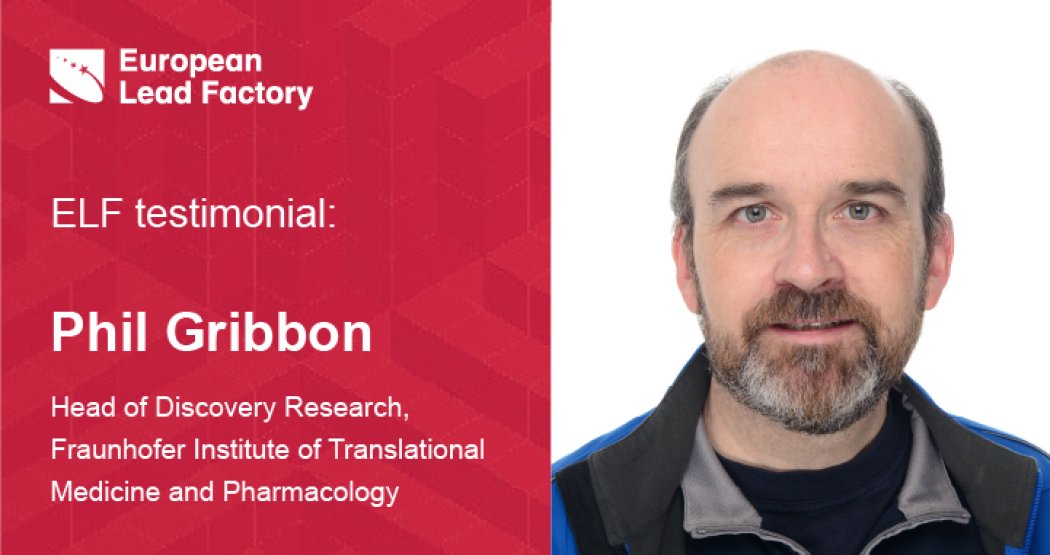
Phil has collaborated with the European Lead Factory (ELF) as the programme owner of a screening programme. We interviewed him about his work and his experience with the ELF.
What can you tell us about your screening programme with the ELF?
I am the programme owner of screening programme on the key viral SARS-CoV-2 virus protein, papain like protease (PLpro), executed in collaboration with the ELF. The origin of the programme was the Horizon Europe project E4C (EXSCALATE4CoV) which started off in early 2020 as part of the emergency response to the COVID-19 pandemic. The project aimed to identify repurposed compounds that could be used for immediate treatment of patients suffering from COVID-19. Within that project we ran a repurposing screen on PLpro and found some interesting compounds, but nothing seemed to warrant further progression from a drug repurposing perspective.
In early 2022, after evaluating a lot of the repurposing opportunities for viral proteins, we decided to invest time in the discovery of novel molecules. We were looking for an opportunity to take the assays that we developed in the compound repurposing setting and see if we could use those to identify new compounds. This is where the ELF opportunity came in, as the ELF provided access to an unparalleled set of compounds, and also has the ability to perform very high throughput screening for biochemical and cell-based assays. So we applied to the ELF, our programme underwent a fast-tracked review, and were accepted.
The ELF has made a big impact across Europe supporting multiple project owners. It is the natural place to go to identify additional chemical matter. In that sense ELF generates starting points for drug discovery programmes and for further optimization towards drugs.
The ELF programme was really well designed to address the issue of compounds interfering with the assay and to validate the hits for our target. We are very happy with the outcomes of the programme and are currently trying to progress those. In fact, based on the results achieved in collaboration with the ELF, we have just received funding for another European project which will start in January 2024. In this project we'll try to and optimise the identified set of hits from the ELF programme, and improve their potency, selectivity versus human proteases and other drug-like properties.
How would you rate the experience you had working with the ELF?
The ELF is extremely professional and well organised, there was a clear application process and the information we had to provide was very reasonable. The process to onboard into the ELF with our programme was relatively straightforward as well. Throughout the project there was clear communication, and all key topics were accompanied by good interaction and great scientific discussions between the ELF and the experts on our side.
We have worked a lot on the structural aspects of assay compounds and it was really great to be able to talk to medicinal chemistry experts from ELF on the biophysical side of the assay and really have a proper scientific conversation.
We were very grateful to receive solid resynthesized material that we are putting into our structural biology pipelines again at the moment. We have also been able to characterise the cell based activity and to perform additional profiling. So overall, our interaction with the ELF was a very positive experience.
What aspects of your collaboration with the ELF made the most impact on your work?
Two things stand out for me. The first was the opportunity that the ELF provided us with mass spectrometry readout. This allowed us to have a high level of confidence in the hits, and that the hit compounds were acting in a biologically meaningful way. The second was the comprehensive suite of biophysical readouts. That helped us to further validate the compounds in thermal shift type assays as well as surface plasmon resonance assays to monitor binding.
These two combined gave us the information that we needed to drill down to a subset of compounds that we wanted to work with and which we are currently moving forward.
What made the ELF compound library attractive to you for your research?
Other libraries available to us were drawn from commercially available compounds primarily. I was interested in the ELF library because it is deliberately designed to not reflect already existing commercially available libraries. Also, the pharma collection of the ELF library does not overlap with the public compound collection of the ELF, which was deliberately designed by medicinal chemistry experts to be novel and complementary. Based on how the library was assembled, it was clear to us that the ELF library would be a drug discovery library that we hoped would give us some strong starting points for finding novel interesting chemical matter.
The ELF project is wrapping up its activities at the end of 2023. What should be preserved from ELF and what can be improved in future similar projects in your opinion?
One of the differences between the ELF and for example, the EU-OPENSCREEN project is the way that data is treated. In the EU-OPENSCREEN project eventually all of the data from the from the screening efforts is made available to the wider community through the European chemical biology database.
In the ELF case there were obviously constraints imposed by the source of the compounds, and the purpose of the ELF. So from the very beginning the ELF was constructed with a high degree of confidentiality on the data. What would be really interesting for me is to look at opportunities to analyse those data in a privacy preserving manner, maybe using a federated approach. This would provide the scientific community and the compound providing companies themselves additional insights from those data and help guide feature drug discovery programmes.
When the ELF started over ten years ago the computational tools to share data in a privacy preserved way weren’t available, but they are now. Certainly, when there are going to be initiatives of this kind in the future this is a topic that should be considered. That is something everybody would benefit from.